Technical Documents
Specifications
Brand
BroadcomMount Type
Surface
Product Type
Optocoupler
Number of Channels
1
Number of Pins
8
Typical Rise Time
1.7μs
Maximum Input Current
230mA
Minimum Operating Temperature
-40°C
Maximum Operating Temperature
105°C
Typical Fall Time
1.7μs
Standards/Approvals
RoHS
Series
ACNT-H79B
Automotive Standard
No
Country of Origin
Philippines
Product Details
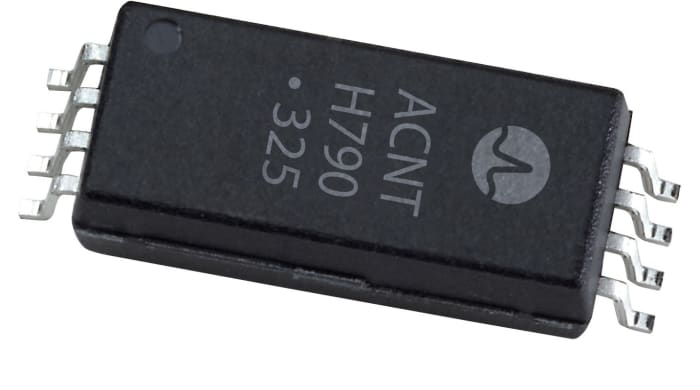
The Broadcom ACNT-H79B isolation amplifiers are designed for current and voltage sensing in electronic power converters for applications including motor drives and renewable energy systems. In a typical motor drive implementation, current flows through an external resistor and the resulting analog voltage drop is sensed by the isolation amplifier. A differential output voltage that is proportional to the current is created on the other side of the optical isolation barrier.
Stock information temporarily unavailable.
₹ 2,204.29
₹ 2,204.29 Each (Exc. GST)
₹ 2,601.06
₹ 2,601.06 Each (inc. GST)
Standard
1
RS Components & Controls (I) Ltd
Distribution hub - B-89, Sector 67, Noida, Gautam Budh Nagar, (Uttar Pradesh), 201 301
₹ 2,204.29
₹ 2,204.29 Each (Exc. GST)
₹ 2,601.06
₹ 2,601.06 Each (inc. GST)
Stock information temporarily unavailable.
Standard
1
| Quantity | Unit price |
|---|---|
| 1 - 9 | ₹ 2,204.29 |
| 10 - 49 | ₹ 2,006.65 |
| 50 - 79 | ₹ 1,951.67 |
| 80+ | ₹ 1,925.30 |
Technical Documents
Specifications
Brand
BroadcomMount Type
Surface
Product Type
Optocoupler
Number of Channels
1
Number of Pins
8
Typical Rise Time
1.7μs
Maximum Input Current
230mA
Minimum Operating Temperature
-40°C
Maximum Operating Temperature
105°C
Typical Fall Time
1.7μs
Standards/Approvals
RoHS
Series
ACNT-H79B
Automotive Standard
No
Country of Origin
Philippines
Product Details
The Broadcom ACNT-H79B isolation amplifiers are designed for current and voltage sensing in electronic power converters for applications including motor drives and renewable energy systems. In a typical motor drive implementation, current flows through an external resistor and the resulting analog voltage drop is sensed by the isolation amplifier. A differential output voltage that is proportional to the current is created on the other side of the optical isolation barrier.